EPS Example Notebook
This notebook shows how fmdtools can be used for static propagation models. Static propagation models are meant to represent events occurring within a time-step (as opposed to over several timesteps). The electric power system used as an examples replicates a previous power system case study implemented in IBFM, and also showcases some basic fault propagation and visualization.
Copyright © 2024, United States Government, as represented by the Administrator of the National Aeronautics and Space Administration. All rights reserved.

The “"Fault Model Design tools - fmdtools version 2"” software is licensed under the Apache License, Version 2.0 (the "License"); you may not use this file except in compliance with the License. You may obtain a copy of the License at http://www.apache.org/licenses/LICENSE-2.0.

Unless required by applicable law or agreed to in writing, software distributed under the License is distributed on an "AS IS" BASIS, WITHOUT WARRANTIES OR CONDITIONS OF ANY KIND, either express or implied. See the License for the specific language governing permissions and limitations under the License.
from fmdtools_examples.electric_power_system.model_main import EPS
import fmdtools.sim.propagate as propagate
This script provides some example I/O for using static models, using the EPS system implemented in eps.py as an example.
A graphical representaiton of this system is shown below:
mdl= EPS()
mg = mdl.as_modelgraph()
fig, ax = mg.draw()
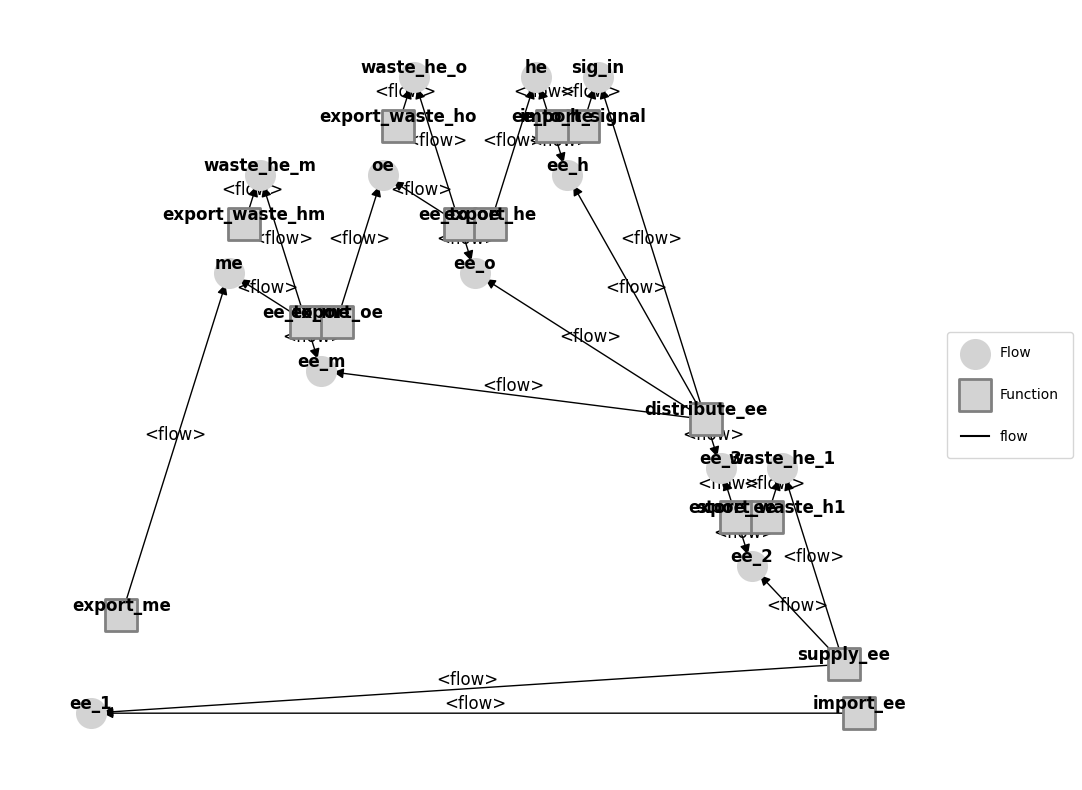
As with dynamic models, in static models we use fp.run_one_fault to see the effects of single faults. All setup is performed in the Model class definition
result, mdlhist = propagate.one_fault(mdl, 'ee_to_me', 'toohigh_torque', to_return=["graph"])
In this case, however, the output in mdlhists will be a single-dimensional dictionary (not something we can plot very well)
fig, ax = mdlhist.plot_line(*mdlhist.nominal.keys())
C:\Users\dhulse\Documents\GitHub\fmdtools\src\fmdtools\analyze\common.py:547: UserWarning: Attempting to set identical low and high xlims makes transformation singular; automatically expanding.
  ax.set_xlim(*xlim)
As a result, it’s better to look at the results graph for a visualization of what went wrong. In this case resgraph better represents the fault propagation of the system than in a dynamic model, since there is only one time-step to represent (rather than a set)
graph = result.get_faulty().tend.graph
graph.set_edge_labels(title='')
fig, ax = graph.draw(figsize=(14,10))
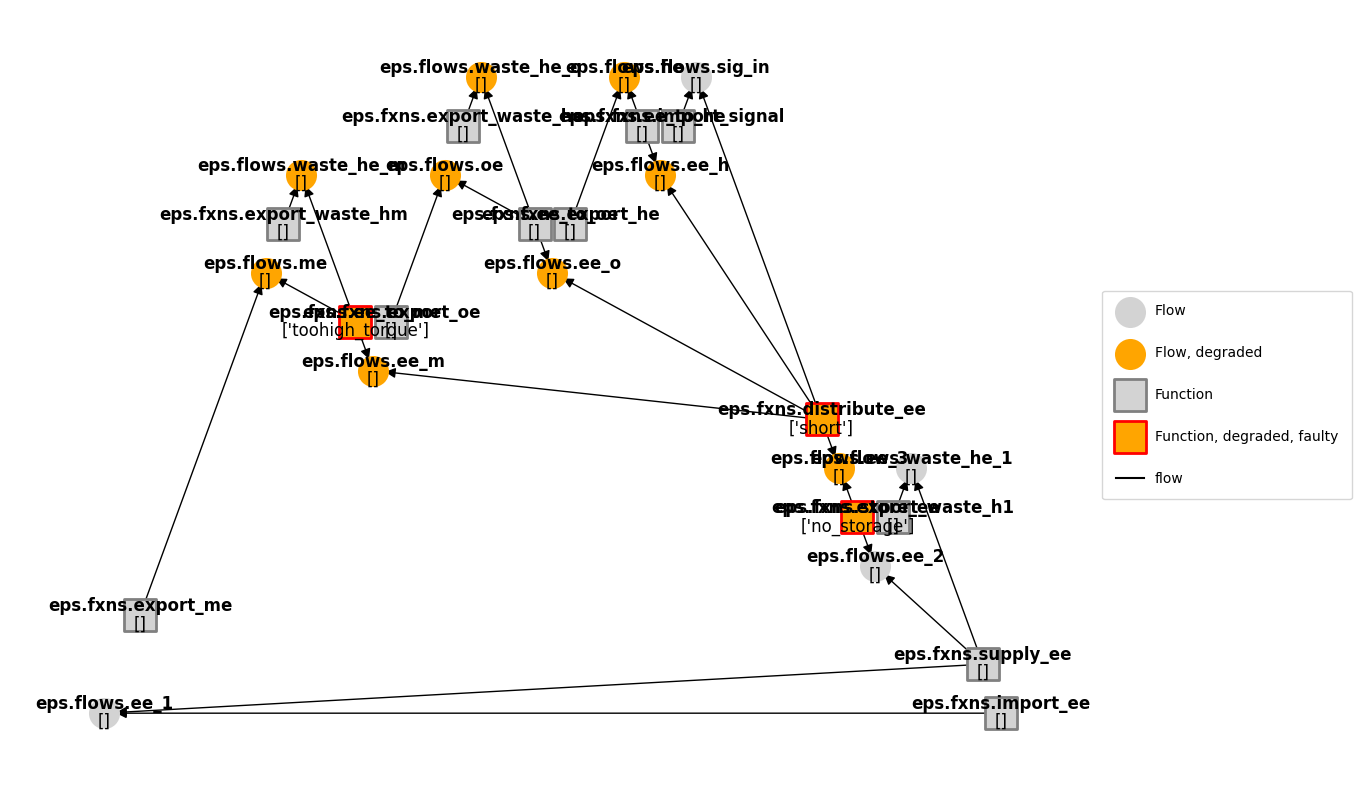
We can run the set of single-fault scenarios on this model using fmdtools.sim.propagate.single_faults. For single-fault scenarios, one does not need to use a SampleApproach, since all faults are injected at a single time-step.
mdl= EPS(track='all')
results, mdlhists = propagate.single_faults(mdl, staged=True)
SCENARIOS COMPLETE: 100%|██████████| 35/35 [00:00<00:00, 75.36it/s]
Using analyze.tabulate.result_summary_fmea, one can see the degradation effects of this fault on the flows:
from fmdtools.analyze.tabulate import result_summary_fmea
tab = result_summary_fmea(results, mdlhists, *mdl.fxns, *mdl.flows)
tab.sort_values("expected_cost")
| degraded | faulty | rate | cost | expected_cost | |
|---|---|---|---|---|---|
| nominal | [] | [] | 1.0 | 0.0 | 0.0 |
| eps_fxns_ee_to_he_open_circuit_t0p0 | ['ee_to_he', 'ee_h', 'he'] | ['ee_to_he'] | 0.0 | 550.0 | 2.409 |
| eps_fxns_supply_ee_open_circuit_t0p0 | ['supply_ee', 'ee_2', 'ee_3', 'ee_m', 'ee_o', ... | ['supply_ee'] | 0.0 | 1450.0 | 3.1755 |
| eps_fxns_ee_to_he_high_heat_t0p0 | ['supply_ee', 'store_ee', 'ee_to_he', 'ee_2', ... | ['supply_ee', 'store_ee', 'ee_to_he'] | 0.0 | 2500.0 | 10.95 |
| eps_fxns_ee_to_oe_optical_resist_t0p0 | ['ee_to_oe', 'ee_o', 'oe', 'he', 'waste_he_o'] | ['ee_to_oe'] | 0.0 | 520.0 | 11.388 |
| eps_fxns_supply_ee_short_t0p0 | ['supply_ee', 'store_ee', 'distribute_ee', 'ee... | ['supply_ee', 'store_ee', 'distribute_ee'] | 0.0 | 5150.0 | 22.557 |
| eps_fxns_ee_to_he_low_heat_t0p0 | ['ee_to_he', 'he'] | ['ee_to_he'] | 0.000002 | 550.0 | 48.18 |
| eps_fxns_ee_to_oe_burnt_out_t0p0 | ['ee_to_oe', 'ee_o', 'oe', 'he', 'waste_he_o'] | ['ee_to_oe'] | 0.000002 | 550.0 | 48.18 |
| eps_fxns_import_signal_no_signal_t0p0 | ['import_signal', 'ee_2', 'ee_3', 'ee_m', 'ee_... | ['import_signal'] | 0.000001 | 2000.0 | 87.6 |
| eps_fxns_ee_to_he_toohigh_heat_t0p0 | ['store_ee', 'distribute_ee', 'ee_to_he', 'ee_... | ['store_ee', 'distribute_ee', 'ee_to_he'] | 0.0 | 5100.0 | 111.69 |
| eps_fxns_supply_ee_adverse_resist_t0p0 | ['supply_ee', 'ee_2', 'ee_3', 'ee_m', 'ee_o', ... | ['supply_ee'] | 0.000002 | 1650.0 | 144.54 |
| eps_fxns_export_waste_ho_ineffective_sink_t0p0 | ['export_waste_ho', 'he', 'waste_he_o'] | ['export_waste_ho'] | 0.000005 | 1000.0 | 219.0 |
| eps_fxns_export_waste_ho_hot_sink_t0p0 | ['export_waste_ho', 'he', 'waste_he_o'] | ['export_waste_ho'] | 0.00001 | 500.0 | 219.0 |
| eps_fxns_export_waste_h1_ineffective_sink_t0p0 | ['export_waste_h1', 'he', 'waste_he_1'] | ['export_waste_h1'] | 0.000005 | 1000.0 | 219.0 |
| eps_fxns_export_waste_h1_hot_sink_t0p0 | ['export_waste_h1', 'he', 'waste_he_1'] | ['export_waste_h1'] | 0.00001 | 500.0 | 219.0 |
| eps_fxns_export_waste_hm_hot_sink_t0p0 | ['export_waste_hm', 'he', 'waste_he_m'] | ['export_waste_hm'] | 0.00001 | 500.0 | 219.0 |
| eps_fxns_export_waste_hm_ineffective_sink_t0p0 | ['export_waste_hm', 'he', 'waste_he_m'] | ['export_waste_hm'] | 0.000005 | 1000.0 | 219.0 |
| eps_fxns_export_he_hot_sink_t0p0 | ['export_he', 'he'] | ['export_he'] | 0.00001 | 600.0 | 262.8 |
| eps_fxns_import_ee_low_v_t0p0 | ['import_ee', 'ee_1', 'ee_2', 'ee_3', 'ee_m', ... | ['import_ee'] | 0.00001 | 700.0 | 306.6 |
| eps_fxns_export_he_ineffective_sink_t0p0 | ['export_he', 'he'] | ['export_he'] | 0.000005 | 1500.0 | 328.5 |
| eps_fxns_supply_ee_major_overload_t0p0 | ['supply_ee', 'store_ee', 'ee_2', 'he', 'waste... | ['supply_ee', 'store_ee'] | 0.000003 | 2600.0 | 341.64 |
| eps_fxns_store_ee_low_storage_t0p0 | ['store_ee'] | ['store_ee'] | 0.000005 | 2000.0 | 438.0 |
| eps_fxns_import_ee_high_v_t0p0 | ['import_ee', 'supply_ee', 'store_ee', 'ee_1',... | ['import_ee', 'supply_ee', 'store_ee'] | 0.000005 | 2300.0 | 503.7 |
| eps_fxns_import_ee_no_v_t0p0 | ['import_ee', 'ee_1', 'ee_2', 'ee_3', 'ee_m', ... | ['import_ee'] | 0.00001 | 1550.0 | 678.9 |
| eps_fxns_store_ee_no_storage_t0p0 | ['store_ee', 'ee_3', 'ee_m', 'ee_o', 'ee_h', '... | ['store_ee'] | 0.000005 | 3250.0 | 711.75 |
| eps_fxns_import_signal_partial_signal_t0p0 | ['import_signal', 'ee_2', 'ee_3', 'ee_m', 'ee_... | ['import_signal'] | 0.00001 | 2000.0 | 876.0 |
| eps_fxns_distribute_ee_adverse_resist_t0p0 | ['distribute_ee', 'ee_2', 'ee_3', 'ee_m', 'ee_... | ['distribute_ee'] | 0.00001 | 2750.0 | 1204.5 |
| eps_fxns_ee_to_me_open_circuit_t0p0 | ['ee_to_me', 'ee_m', 'me', 'he', 'waste_he_m'] | ['ee_to_me'] | 0.00005 | 650.0 | 1423.5 |
| eps_fxns_distribute_ee_poor_alloc_t0p0 | ['distribute_ee', 'ee_2', 'ee_3', 'ee_m', 'ee_... | ['distribute_ee'] | 0.00002 | 1750.0 | 1533.0 |
| eps_fxns_ee_to_me_high_torque_t0p0 | ['ee_to_me', 'ee_m', 'me', 'he', 'waste_he_m'] | ['ee_to_me'] | 0.0001 | 450.0 | 1971.0 |
| eps_fxns_supply_ee_minor_overload_t0p0 | ['supply_ee', 'store_ee', 'distribute_ee', 'ee... | ['supply_ee', 'store_ee', 'distribute_ee'] | 0.00001 | 5150.0 | 2255.7 |
| eps_fxns_distribute_ee_open_circuit_t0p0 | ['distribute_ee', 'ee_2', 'ee_3', 'ee_m', 'ee_... | ['distribute_ee'] | 0.00003 | 2750.0 | 3613.5 |
| eps_fxns_distribute_ee_short_t0p0 | ['store_ee', 'distribute_ee', 'ee_3', 'ee_m', ... | ['store_ee', 'distribute_ee'] | 0.00002 | 4750.0 | 4161.0 |
| eps_fxns_ee_to_me_short_t0p0 | ['store_ee', 'distribute_ee', 'ee_to_me', 'ee_... | ['store_ee', 'distribute_ee', 'ee_to_me'] | 0.00005 | 4950.0 | 10840.5 |
| eps_fxns_ee_to_me_toohigh_torque_t0p0 | ['store_ee', 'distribute_ee', 'ee_to_me', 'ee_... | ['store_ee', 'distribute_ee', 'ee_to_me'] | 0.00005 | 5050.0 | 11059.5 |
| eps_fxns_ee_to_me_low_torque_t0p0 | ['store_ee', 'distribute_ee', 'ee_to_me', 'ee_... | ['store_ee', 'distribute_ee', 'ee_to_me'] | 0.0001 | 4950.0 | 21681.0 |