Cooling Tank
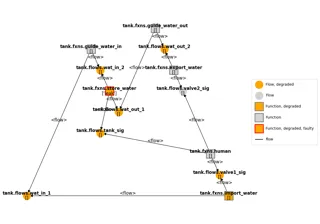
This is a fairly simple model of a cooling tank, inlet valve, and outlet valve. It includes a demonstration of the model and optimization of said model.
Further description and use of the model is given in the provided notebooks:
References:
Irshad, L., Hulse, D., Demirel, H. O., Tumer, I. Y., and Jensen, D. C. (May 3, 2021). “Quantifying the Combined Effects of Human Errors and Component Failures.” ASME. J. Mech. Des. October 2021; 143(10): 101703. https://doi.org/10.1115/1.4050402
Hulse, D., and Hoyle, C. (August 8, 2022). “Understanding Resilience Optimization Architectures: Alignment and Coupling in Multilevel Decomposition Strategies.” ASME. J. Mech. Des. November 2022; 144(11): 111704. https://doi.org/10.1115/1.4054993
Package Structure
Models:
tank_model.py: Base tank model.
tank_optimization_model.py: Tank model used for optimization
Scripts and tests:
test_tank.py: Tests various tank behaviors.
Notebooks
Demo: Cooling Tank Model uses the
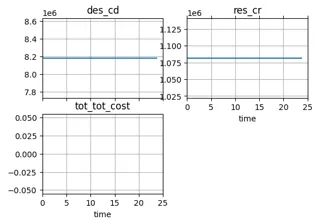
SampleApproachclass to model human interactions with the modeled system (in model_main.py).Paper: Optimization Architecture Comparison shows how design and contingency management of a system (in model_optimization.py) can be co-optimized with the
ProblemArchitectureclass, as well as external solvers.
The support files include various implementations of the tank model.
The baseline Tank Model (model_tank.py), a dynamical implementation of a human-operated tank system to show how fmdtools can be used to model human errors.
A demonstration Optimization Tank Model (model_optimization.py), along with resilience optimization architectures using
ProblemArchitecture.