
UQPCE#
With the data files included, the user can run UQPCE using the input casefiles and compare the mean, variance, and confidence intervals with the results in this section. Files containing the data from the Monte Carlo Simulation approach will be provided upon request. These examples are included to demonstrate the use of UQPCE for varying problems.
Transonic NACA 0012 Airfoil#
Background#
The lift coefficient (CL) and drag coefficient (CD) of a NACA 0012 airfoil are studied in the case of transonic flight running an RANS CFD code. The inputs for the simulation are the Mach number, angle of attack (alpha), altitude, von Karman constant, and turbulent Prandtl number.
Outputs#
When you execute the module, you should get results similar to those below.
UQPCE |
Monte Carlo |
|
|---|---|---|
mean |
0.21875 |
0.21875 |
variance |
1.425e-4 |
1.420e-4 |
confidence interval |
[0.1843, 0.2484] |
[0.1950, 0.2412] |
UQPCE |
Monte Carlo |
|
|---|---|---|
mean |
0.028205 |
0.028204 |
variance |
1.236e-06 |
1.231e-06 |
confidence interval |
[0.0253, 0.0313] |
[0.0261, 0.0304] |
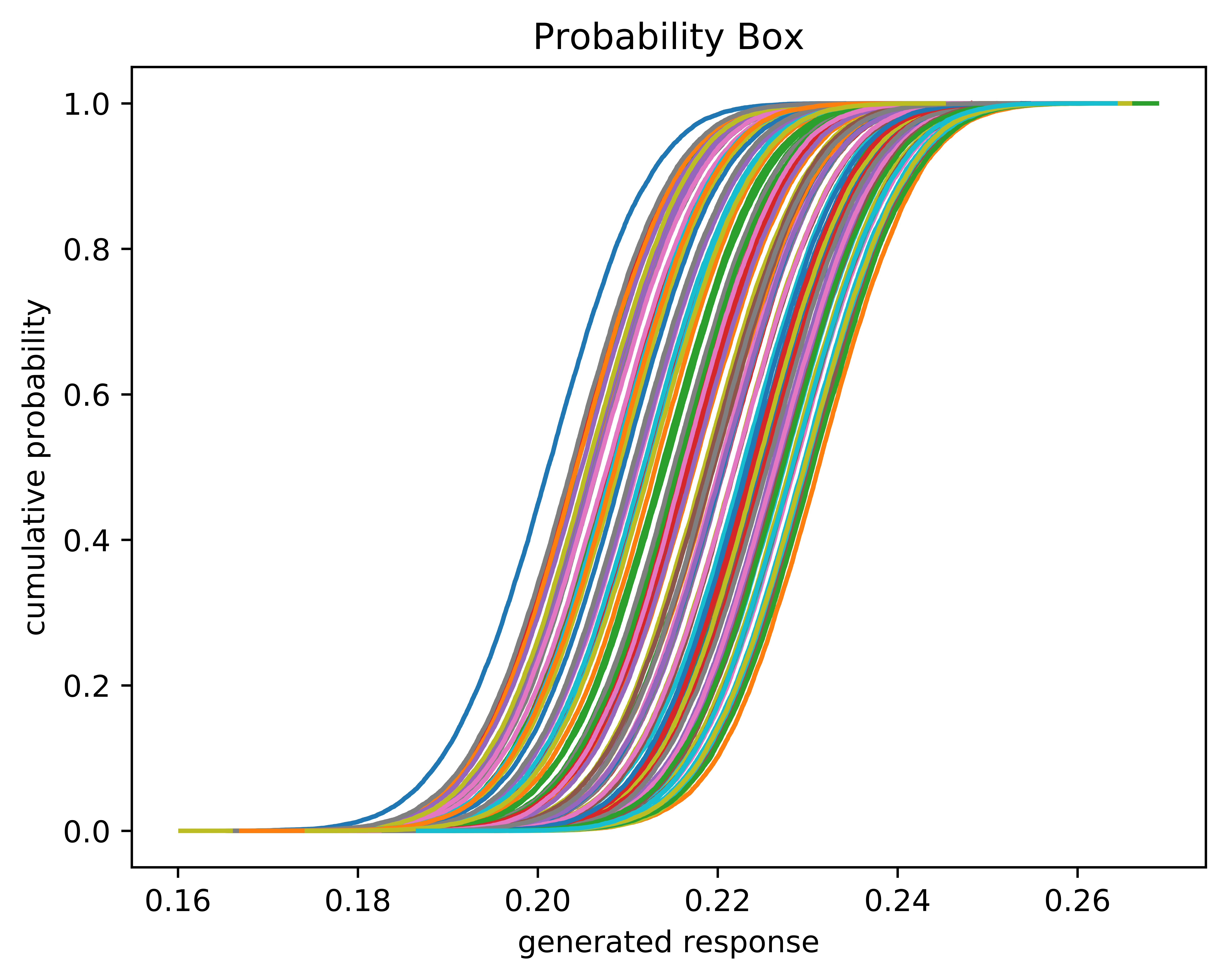
Fig. 14 The 95% confidence interval of the lift coefficient is found by interpolating to find the values that belong at 2.5% and 97.5% of the responses.#
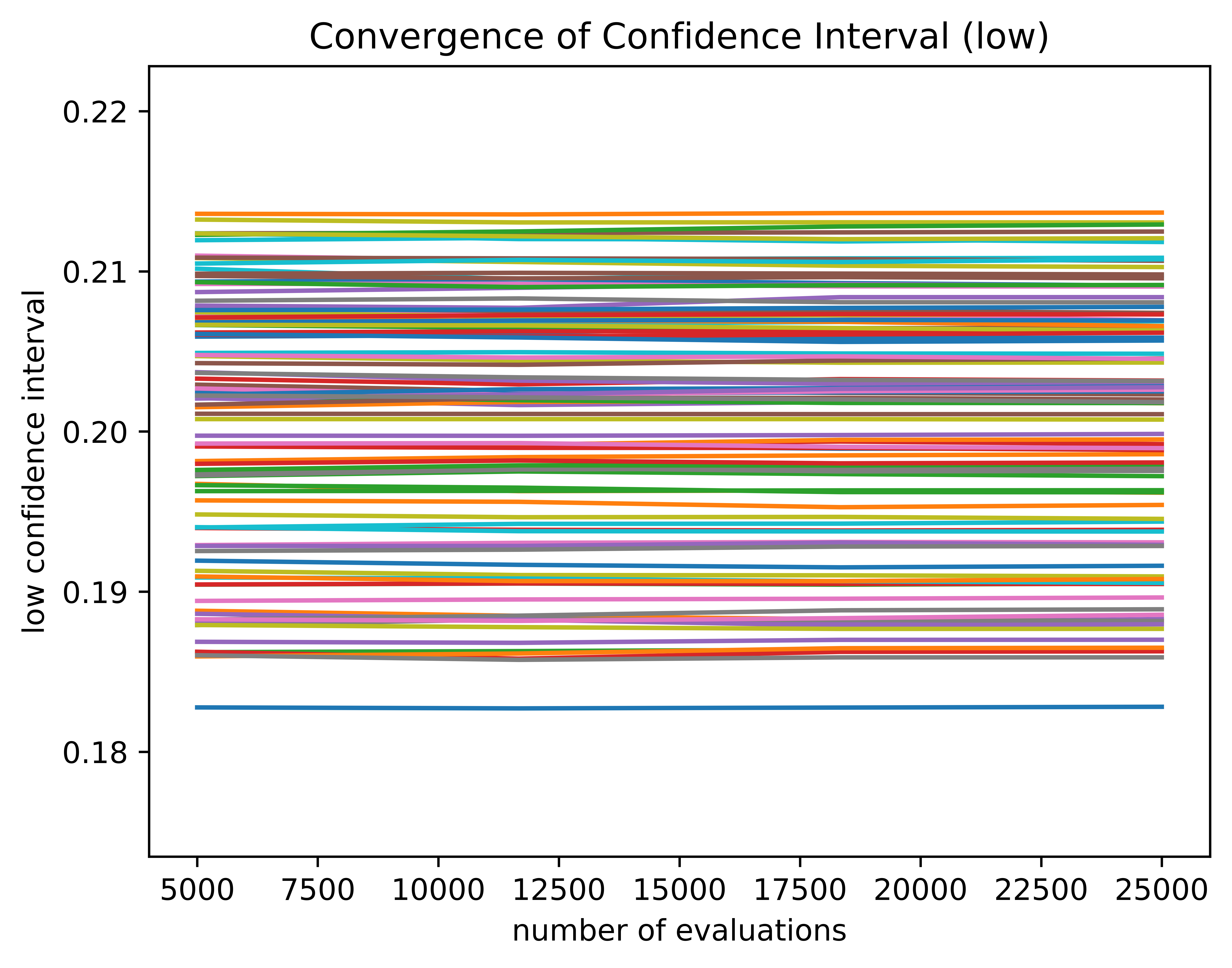
Fig. 15 The lower confidence intervals of the lift coefficient for each curve converging with additional evaluations.#
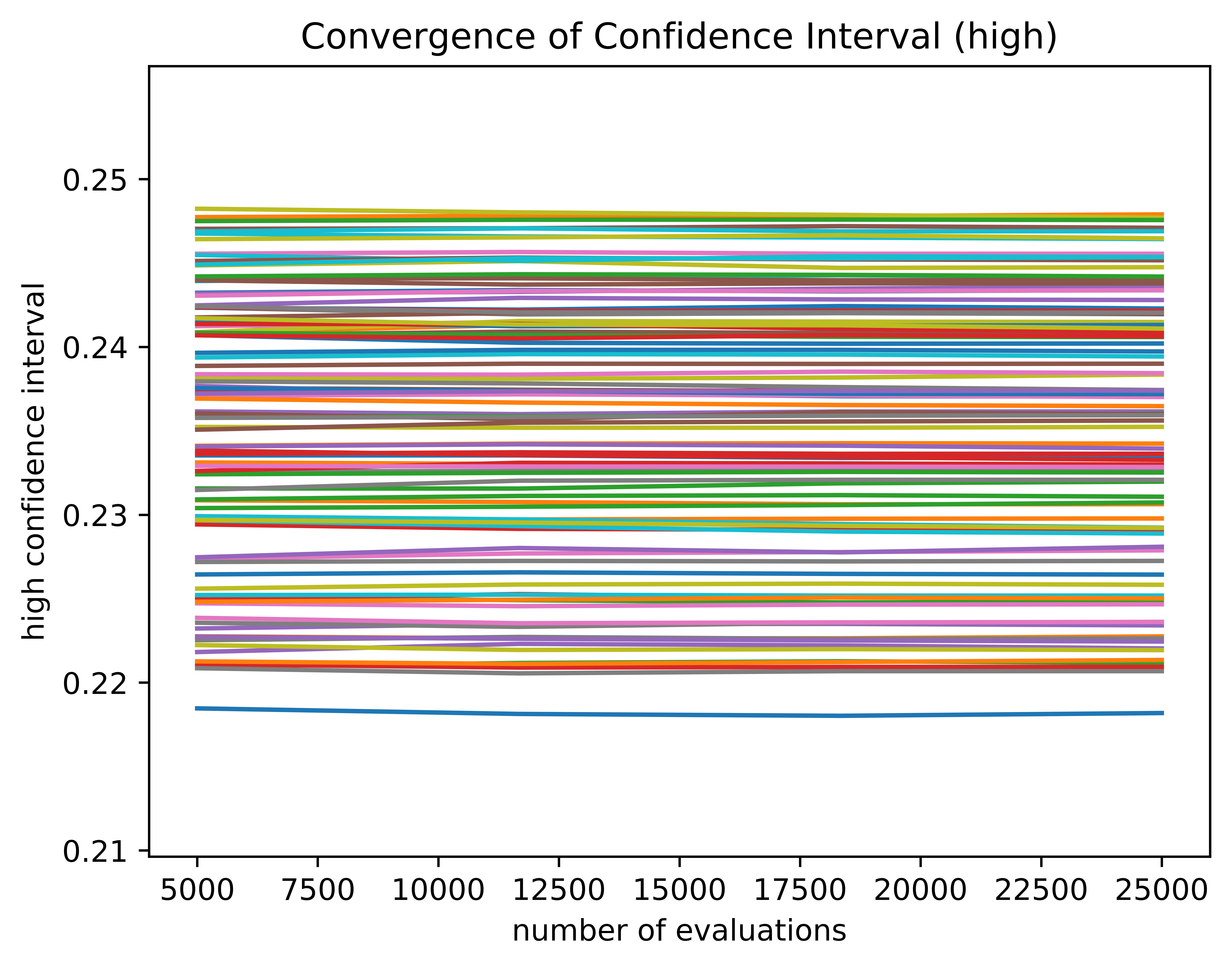
Fig. 16 The convergence of the upper intervals of the lift coefficient coefficient for each curve converging with additional evaluations.#
Along with these convergence plots of the individual curves, the sets of curves have their overall convergence intervals written to a file.
The corresponding output of this file for the lift coefficient is shown below:
set: [0.18745724466451097, 0.24735395659860618]
set: [0.18607906409253214, 0.2475065011187474]
set: [0.18607906409253214, 0.2475065011187474]
set: [0.18607906409253214, 0.24759772917464634]
If the --verify flag is used with the included files, the user should get an output similar to the following for the lift coefficient:
Mean error between model and verification 3.146e-05
The user should get an output similar to the following for the drag coefficient:
Mean error between model and verification 1.3294e-06
Supersonic Diamond Airfoil#
Background#
The ground noise, obtained from the off-body pressure signature, is the response of interest in the case of the diamond airfoil. The inputs are the Mach number, the angle of attack (AoA), ground altitude, reflection factor (RF), x-velocity of wind, y-velocity of wind, relative humidity (hum), and temperature.
Outputs#
When you run these files, you should get similar results to those below.
UQPCE |
Monte Carlo |
|
|---|---|---|
mean |
100.9 |
100.87 |
variance |
0.098999 |
0.090497 |
confidence interval |
[100.13, 101.72] |
[100.31, 101.46] |
If the --verify flag is used with the included files, the user should get an output similar to the following for the lift coefficient:
Mean error between model and verification 0.0086068
This value is similar to the mean error of the surrogate, 0.0061665, which suggests that the model is a good fit for the data.
UQPCE |
Monte Carlo |
|
|---|---|---|
mean |
116.5 |
116.48 |
variance |
0.0781 |
0.0718 |
confidence interval |
[115.92, 117.12] |
[116.01, 116.97] |
If the --verify flag is used with the included files, the user should get an output similar to the following for the lift coefficient:
Mean error between model and verification 0.0016291
This value is similar to the mean error of the surrogate, 0.0010945, which suggests that the model is a good fit for the data.
UQPCE |
Monte Carlo |
|
|---|---|---|
mean |
116.29 |
116.26 |
variance |
0.1224 |
0.1124 |
confidence interval |
[115.53, 117.17] |
[115.46, 117.1] |
The above chart shows the UQPCE versus Monte Carlo mean, variance, and confidence intervals for the perceived loudness (PLdB).
If the --verify flag is used with the included files, the user should get an output similar to the following for the lift coefficient:
Mean error between model and verification 0.012474
This value is similar to the mean error of the surrogate, 0.0079942, which suggests that the model is a good fit for the data.
OneraM6 Airfoil#
Background#
The lift coefficient (CL) and drag coefficient (CD) OneraM6 airfoil are studied. The inputs for the simulation are the Mach number and angle of attack.
Outputs#
When you run these files, you should get results similar to those below.
UQPCE |
Monte Carlo |
|
|---|---|---|
mean |
0.29296 |
0.29288 |
variance |
2.713e-4 |
2.739e-4 |
confidence interval |
[0.26163, 0.3262] |
[0.2611, 0.3259] |
If the --verify flag is used, you will see output similar to below:
Mean error between model and verification 7.3086e-05
This value is similar to the mean error of the surrogate, 2.8925e-05, which suggests that the model is a good fit for the data.
UQPCE |
Monte Carlo |
|
|---|---|---|
mean |
0.01767 |
0.01766 |
variance |
3.660e-06 |
3.686e-06 |
confidence interval |
[0.0145, 0.0219] |
[0.0144, 0.0219] |
If the --verify flag is used, you will see output similar to below:
Mean error between model and verification 1.1883e-05
This value is similar to the mean error of the surrogate, 2.8941e-06, which suggests that the model is a good fit for the data.
The below plots are created using the --plot and --plot-stand flags. They represent the outputs for the drag coefficient case with order = 3.
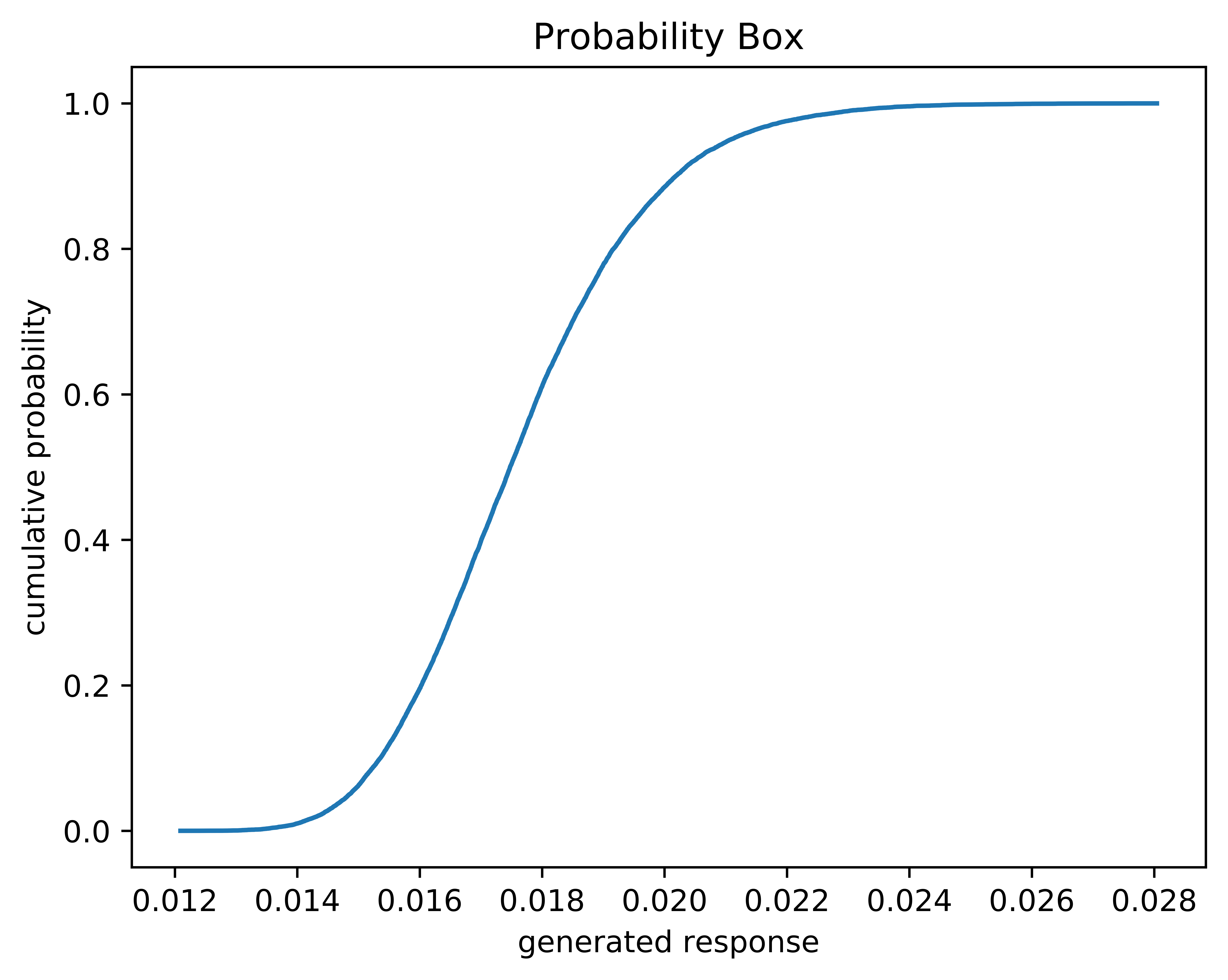
Fig. 17 The lift coefficient probability box for the OneraM6 airfoil.#
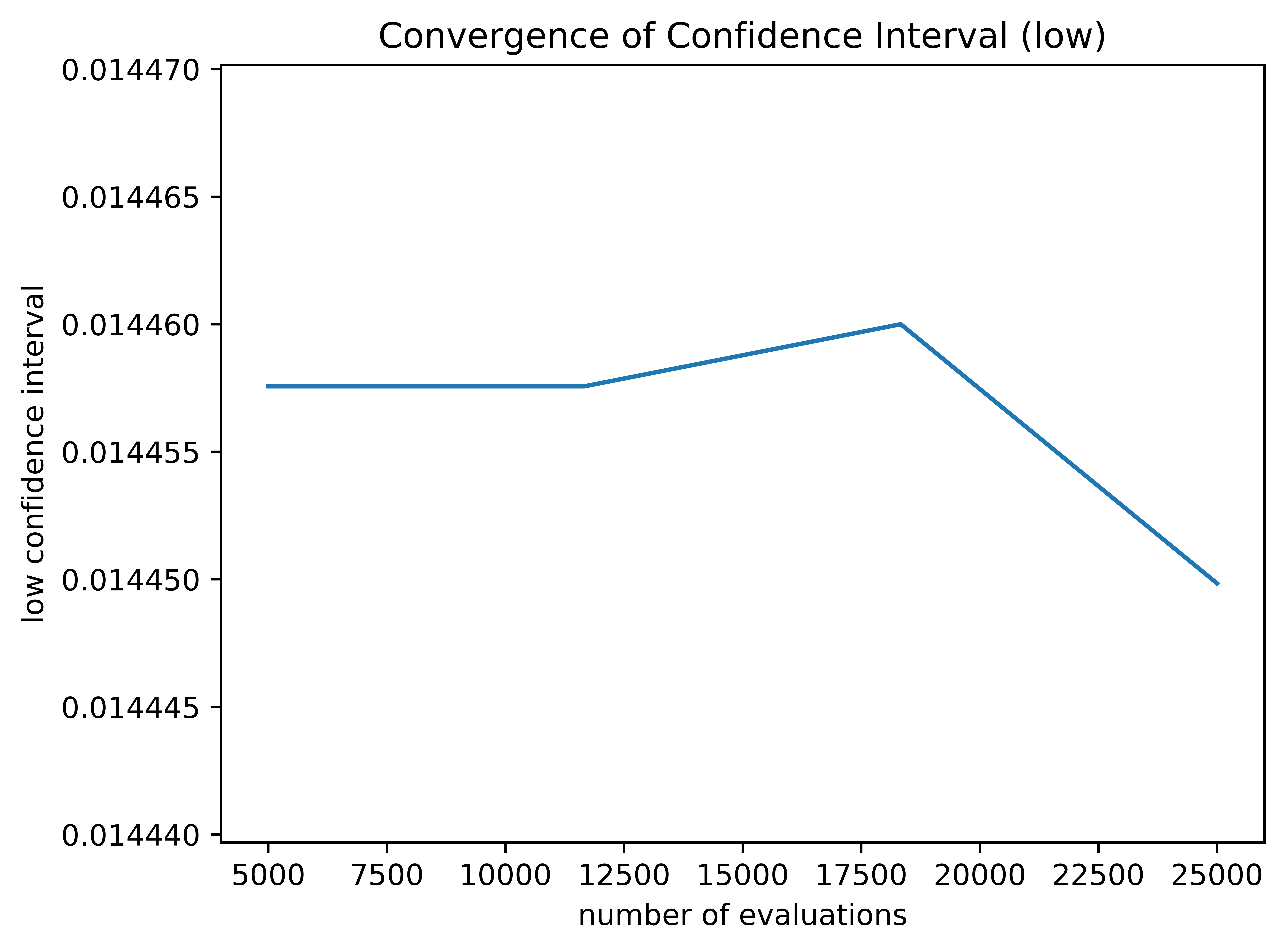
Fig. 18 The convergence of the lower confidence interval for the OneraM6 airfoil.#
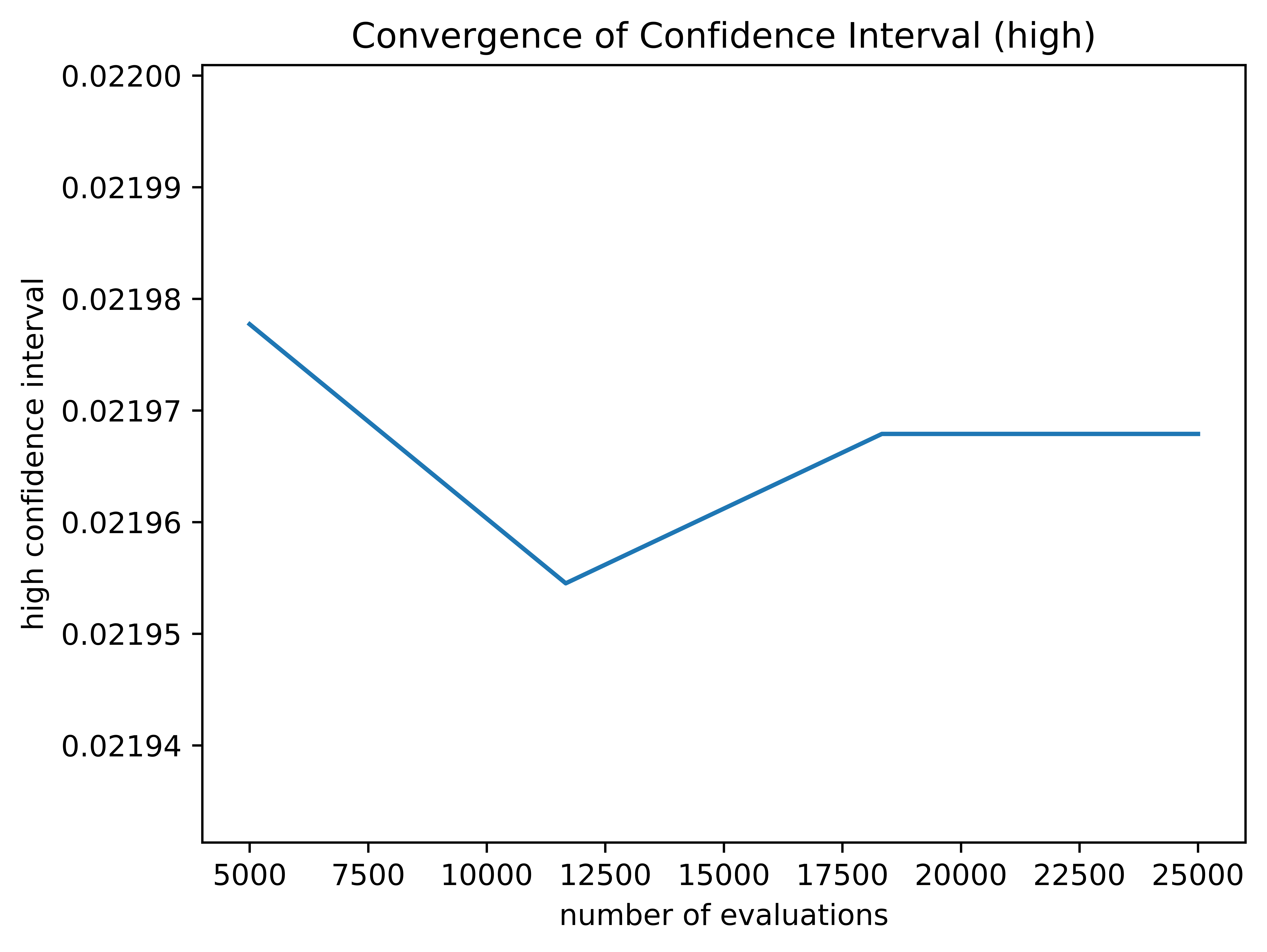
Fig. 19 The convergence of the upper confidence interval for the OneraM6 airfoil.#
The file containing the convergence values looks like the following:
low:  [0.014457565322569664, 0.014457565322569664, 0.01445999863254389, 0.014449842360062486]
high: [0.021977720803637357, 0.02195451100712743, 0.021967892240129253, 0.021967892240129253]
The above figures show the probability box plot and the lower and upper confidence interval convergence for the OneraM6 airfoil case. Since none of the variables are epistemic, there is only one curve for the probability box. As shown, these confidence intervals did not converge within the accepted threshold and instead used the maximum number of samples allowed. It is possible for the curves to converge and not appear to be converged as long as the last two differences between confidence intervals are within the specified convergence threshold.
Analytical Case#
Background#
This case is included to demonstrate a case which uses all of the common variable types- normal, uniform, exponential, beta, and gamma. In addition to using all variable types, the values of the variables were generated using distributions from MATLAB, and an equation was used to generate the corresponding response. Since this example is completely analytical, we can solve for the exact Sobol values for comparison.
The equation used to generate the responses is given by
Using properties of the variance operator below,
where \(Var\) is the variance, \(Cov\) is the covariance, and \(E\) is the expected value (mean), the expression for the variance of the function \(f\), is given by:
Variance for the distributions of the independent variables are given in table below.
Distribution |
Probability Density |
Mean |
Variance |
|---|---|---|---|
normal |
\(\frac{1}{\sqrt{2\pi\sigma^2}}e^{\frac{-(x-\mu)^2}{2\sigma^2}}\) |
\(\mu\) |
\(\sigma^2\) |
uniform |
\(\frac{1}{b-a}\) |
\(\frac{1}{2}(a+b)\) |
\(\frac{1}{12}(b-a)^2\) |
exponential |
\(\lambda e^{-\lambda x}\) |
\(\frac{1}{\lambda}\) |
\(\frac{1}{\lambda^2}\) |
beta |
\(\frac{x^{\alpha-1}(1-x)^{\beta-1}}{B(\alpha,\beta)}\) |
\(\frac{\alpha}{\alpha+\beta}\) |
\(\frac{\alpha\beta}{(\alpha+\beta)^2(\alpha+\beta+1)}\) |
gamma |
\(\frac{1}{\Gamma(\alpha)\theta^\alpha}x^{\alpha-1}e^{\frac{-x}{\theta}}\) |
\(\alpha\theta\) |
\(\alpha\theta^2\) |
Evaluating the variances for each of the independent parameters gives \(Var(x_0)=0.25\), \(Var(x_1)=0.0208\), \(Var(x_2)=0.111\), \(Var(x_3)=0.0457\), \(Var(x_4)=0.25\). Substituting into Eq. (22) yields
Calculations for the covariance and expected quantity terms are left to the reader. Simplifying yields: \(Var(f) = 6.674\). To determine the total Sobol indices for this analytical function, the total variance is decomposed into individual variable contributions. For variables that do not have any interaction components, i.e. \(x_0x_1\), the decomposition is straight forward. The Sobol indices for \(x_2\), \(x_3\) and \(x_4\) are given below.
For \(x_4\) the total Sobol index includes the variance contributions from the quadratic terms as well.
Sobol indices for \(x_0\) and \(x_1\) calculations are slightly more involved do to the interaction present. The variance contribution from the interaction term must be proportioned based on the ratio of the variable individual variances.
Outputs#
UQPCE |
Monte Carlo |
|
|---|---|---|
mean |
9.8 |
9.7989 |
variance |
6.6741 |
6.6727 |
confidence interval |
[5.6205, 15.5860] |
[5.6365, 15.5405] |
This shows similar results as above. This case has data that has no units and no physical meaning, and we still see that the results are similar between using UQPCE and Monte Carlo sampling the system.
UQPCE |
Analytical Results |
|
|---|---|---|
Sobol 0 |
0.3376 |
0.338 |
Sobol 1 |
0.0289 |
0.028 |
Sobol 2 |
0.1497 |
0.150 |
Sobol 3 |
0.1095 |
0.110 |
Sobol 4 |
0.3743 |
0.374 |
Verifying the Sobol sensitivities is not something that can be done to a system in which the underlying function is unknown. Since the underlying function is known in this case, the Sobol indices can be calculated.
If the --verify flag is used, you will see output similar to below:
Mean error between model and verification 2.3093e-14
This value is similar to the mean error of the surrogate, 2.6272e-14, which suggests that the model is a good fit for the data.
High Order Analytical Case#
Background#
This case is included to demonstrate a case using a high order response and PCE model. In addition to using all variable types, the values of the variables were generated using distributions from MATLAB, and an equation was used to generate the corresponding response. Since this example allows us to know the exact values for responses when Monte Carlo sampling the system, the correct Sobol values in addition to the mean and variance can be found.
The equation used to generate the responses is given by
Outputs#
UQPCE |
Monte Carlo |
|
|---|---|---|
mean |
11.409 |
11.403 |
variance |
418.27 |
421.18 |
confidence interval |
[0.2492, 40.507] |
[0.2542, 40.205] |
This shows similar results as above. This case has data that has no units and no physical meaning, and we still see that the results are similar between using UQPCE and Monte Carlo sampling the system.
UQPCE |
Monte Carlo |
|
|---|---|---|
Sobol 0 |
0.0399 |
0.0404 |
Sobol 1 |
0.1504 |
0.1530 |
Sobol 2 |
0.2993 |
0.3008 |
Sobol 3 |
0.3094 |
0.3135 |
Sobol 4 |
0.2011 |
0.1926 |
Verifying the Sobol sensitivities is not something that can be done to a system in which the underlying function is unknown. Since the underlying function is known in this case, the Sobol indices can be calculated.
If the --verify flag is used, you will see output similar to below:
Mean error between model and verification 2.7579e-09
This value is similar to the mean error of the surrogate, 2.9757e-09, which suggests that the model is a good fit for the data.
User Input Variable Case#
Background#
This case is included to demonstrate the accuracy and flexibility of inputting variables according to their equation instead of variable type.
Note
Using the equation approach for inputting a variable of one of the variable types (normal, uniform, beta, exponential, and gamma) is not recommended when running the program. It will give you equivalent outputs, but the equation-based approach is much slower than the using the variable types.
The equation used to generate the responses is given by Eq. (18).
Outputs#
UQPCE |
Monte Carlo |
|
|---|---|---|
mean |
17.645 |
17.643 |
variance |
15.225 |
15.219 |
confidence interval |
[10.591, 25.657] |
[10.731, 25.864] |
UQPCE |
Monte Carlo |
|
|---|---|---|
Sobol 0 |
0.1199 |
0.1198 |
Sobol 1 |
0.3230 |
0.3231 |
Sobol 2 |
0.0328 |
0.0329 |
Sobol 3 |
0.4912 |
0.4912 |
Sobol 4 |
0.0422 |
0.0422 |
If the --verify flag is used, you will see output similar to below:
Mean error between model and verification 4.2751e-14
This value is similar to the mean error of the surrogate, 2.8777e-14, which suggests that the model is a good fit for the data.
Interval Case#
Background#
This case is included to demonstrate the accuracy of modeling distributions with non-standard bounds on variables.
The equation used to generate the responses is given by
Outputs#
UQPCE |
Monte Carlo |
|
|---|---|---|
mean |
123.6 |
123.60 |
variance |
2567.5 |
2566.85 |
confidence interval |
[54.931, 249.540] |
[54.267, 248.388] |
UQPCE |
Monte Carlo |
|
|---|---|---|
Sobol 0 |
0.0034 |
0.0035 |
Sobol 1 |
0.0042 |
0.0042 |
Sobol 2 |
0.1995 |
0.1994 |
Sobol 3 |
0.0011 |
0.0011 |
Sobol 4 |
0.0025 |
0.0026 |
Sobol 5 |
0.8113 |
0.8113 |
If the --verify flag is used, you will see output similar to below:
Mean error between model and verification 0.014425
This value is similar to the mean error of the surrogate, 0.0044884, which suggests that the model is a good fit for the data.
Small Mean Case#
Background#
This case is included to demonstrate the accuracy of a case with a small mean.
The equation used to generate the responses is given by
Outputs#
UQPCE |
Monte Carlo |
|
|---|---|---|
mean |
6.4413e-7 |
6.4412e-07 |
variance |
1.6863e-14 |
1.6860e-14 |
confidence interval |
[4.073e-7, 9.137e-7] |
[4.060e-07, 9.140e-07] |
UQPCE |
Monte Carlo |
|
|---|---|---|
Sobol 0 |
0.0237 |
0.0237 |
Sobol 1 |
0.2123 |
0.2124 |
Sobol 2 |
0.3012 |
0.3011 |
Sobol 3 |
0.1647 |
0.1648 |
Sobol 4 |
0.1379 |
0.1377 |
Sobol 5 |
0.1779 |
0.1780 |
If the --verify flag is used, you will see output similar to below:
Mean error between model and verification 5.1457e-22
This value is similar to the mean error of the surrogate, 3.7852e-22, which suggests that the model is a good fit for the data.
Discrete Case#
Background#
This case is included to demonstrate the use of the discrete variables.
The equation used to generate the responses is given by
Outputs#
UQPCE |
Monte Carlo |
|
|---|---|---|
mean |
47.366 |
47.366 |
variance |
190.33 |
190.37 |
confidence interval |
[24.44, 76.76] |
[24.37, 76.48] |
UQPCE |
Monte Carlo |
|
|---|---|---|
Sobol 0 |
0.0213 |
0.0213 |
Sobol 1 |
0.0673 |
0.0672 |
Sobol 2 |
0.0175 |
0.0175 |
Sobol 3 |
0.0113 |
0.0113 |
Sobol 4 |
0.0170 |
0.0170 |
Sobol 5 |
0.1449 |
0.1449 |
Sobol 6 |
0.0941 |
0.0938 |
Sobol 7 |
0.6266 |
0.6266 |
If the --verify flag is used, you will see output similar to below:
Mean error between model and verification 1.1622e-12
This value is similar to the mean error of the surrogate, 1.1623e-12, which suggests that the model is a good fit for the data.
Discrete Parabola Case#
Background#
This case is included to demonstrate the use of the discrete variables.
The equation used to generate the responses is given by
Variances for the distributions of the variables are given in table below.
Using the mean of each variable to hold the variables constant, the Sobols are calculated using one-variable-at-a-time variable decomposition. The means of the independent variables are given in the above table.
Outputs#
UQPCE |
Monte Carlo |
|
|---|---|---|
mean |
12.416 |
12.416 |
variance |
48.815 |
48.824 |
confidence interval |
[-0.027, 27.79] |
[-0.04, 27.84] |
UQPCE |
Monte Carlo |
|
|---|---|---|
Sobol 0 |
0.2887 |
0.2888 |
Sobol 1 |
0.1554 |
0.1553 |
Sobol 2 |
0.2724 |
0.2722 |
Sobol 3 |
0.2836 |
0.2835 |
If the --verify flag is used, you will see output similar to below:
Mean error between model and verification 5.4386e-14
This value is similar to the mean error of the surrogate, 3.0609e-14, which suggests that the model is a good fit for the data.
User Input Continuous and Discrete Case#
Background#
This case is included to demonstrate the use of both continuous and discrete user input variables in the same case.
The equation used to generate the responses is given by
Outputs#
UQPCE |
Monte Carlo |
|
|---|---|---|
mean |
9.4994 |
9.4995 |
variance |
3.8326 |
3.8332 |
confidence interval |
[5.739, 13.505] |
[5.683, 13.490] |
UQPCE |
Monte Carlo |
|
|---|---|---|
Sobol 0 |
0.1099 |
0.1100 |
Sobol 1 |
0.0870 |
0.0868 |
Sobol 2 |
0.0235 |
0.0235 |
Sobol 3 |
0.1220 |
0.1219 |
Sobol 4 |
0.2854 |
0.2855 |
Sobol 5 |
0.2348 |
0.2348 |
Sobol 6 |
0.0905 |
0.0904 |
Sobol 7 |
0.0469 |
0.0470 |
If the --verify flag is used, you will see output similar to below:
Mean error between model and verification 2.5882e-13
This value is similar to the mean error of the surrogate, 2.7263e-13, which suggests that the model is a good fit for the data.