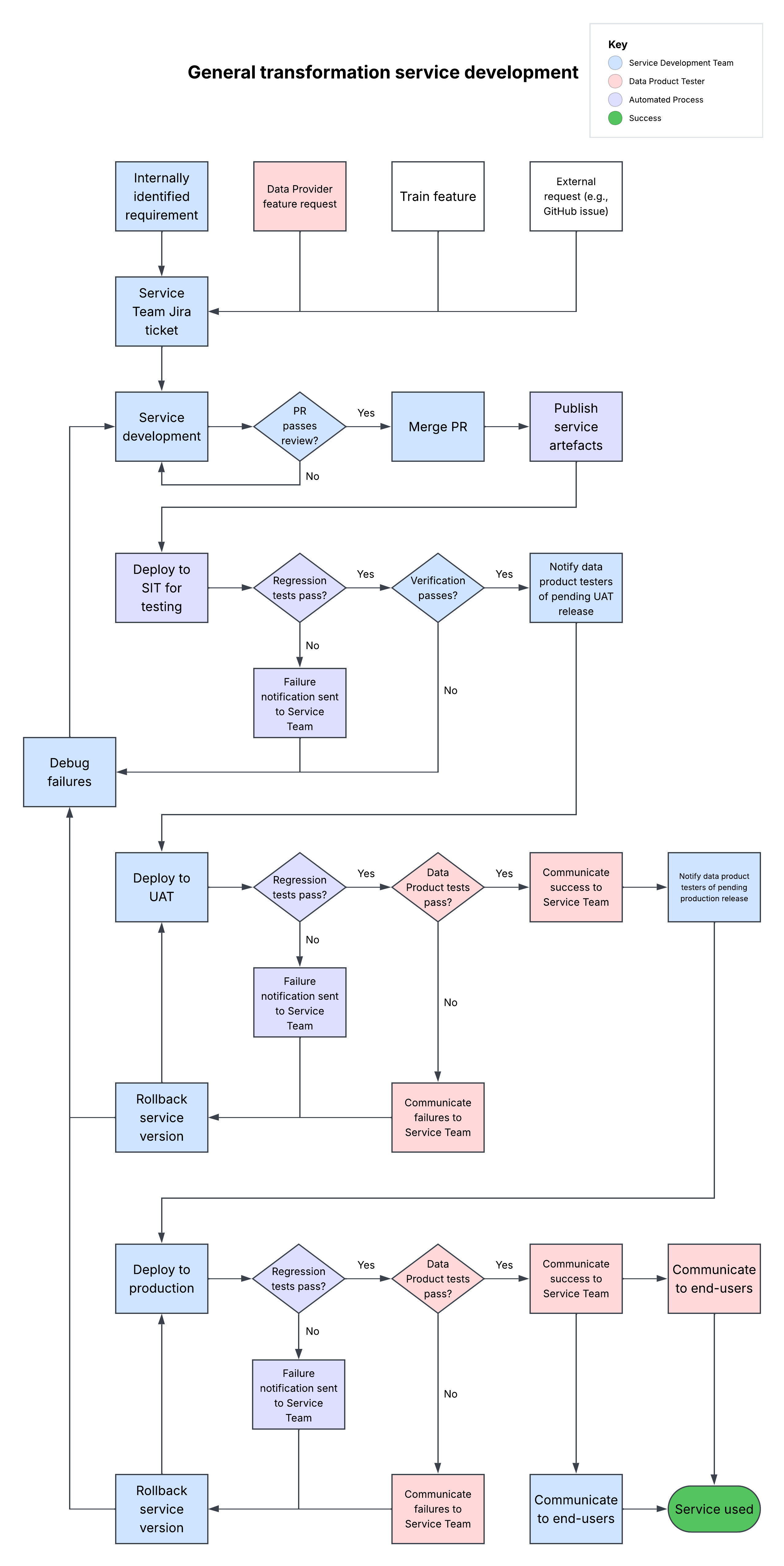
Scenario: New feature is developed
The Harmony service development workflow includes unique interactions between the Harmony Core and Harmony backend service development teams (see ?@fig-harmony-service). As such, both a generalized and Harmony-specific feature workflow are illustrated below.
Publishing and releasing a new version of a service:
Data providers and testers at the DAACs need to be able to easily understand the features (tickets) contained in each release of a service. To achieve this:
- Please include commit history in the GitHub release notes. For an example on release note generation, please see this script.
- When announcing a release of a published service version to a Harmony environment in the harmony-service-providers Slack channel, please either include the exact release notes from GitHub and/or include a link to the GitHub release page.
- On each Jira ticket adding, removing or changing a feature in a service, please indicate the service version that those changes are included in via a comment or other mechanism.
Deployment Cycle:
- SIT - should receive all new published artefacts in order to allow service maintainers to test the new version of the service.
- UAT - artefacts will be promoted to UAT on successful SIT testing.
- Production - artefacts to be promoted to production following successful stakeholder testing in UAT or 2 weeks, whichever is sooner. Exception: failed tests in UAT blocks promotion to production.
Workflow: